Robert Oppenheimer
American theoretical physicist, known as "father of the atomic bomb" (1904–1967)
Message board for Robert Oppenheimer fans
Share your thoughts. Text only — no URLs, phones, emails, @handles, or crypto addresses. First name / display name is fine; no account needed.
Robert Oppenheimer
J. Robert Oppenheimer (born Julius Robert Oppenheimer OP-ən-hy-mər; April 22, 1904 – February 18, 1967) was an American theoretical physicist who served as the director of the Manhattan Project's Los Alamos Laboratory during World War II. He is often called the "father of the atomic bomb" for his role in overseeing the development of the first nuclear weapons.
Born: 1904-04-22 · Died: 1967-02-18
Lore in one paragraph
Newbie mode. J. Robert Oppenheimer was the American physicist who ran Los Alamos during World War II and built the first atomic bombs. On 16 July 1945 his team detonated 'Trinity' in the New Mexico desert, and three weeks later the weapons obliterated Hiroshima and Nagasaki. Haunted by what he'd helped create — he later said the flash made him think of a line from the Bhagavad Gita, 'Now I am become Death, the destroyer of worlds' — he spent the rest of his life arguing for arms control. In 1954, at the height of the Red Scare, his enemies stripped him of his security clearance in a rigged hearing; the U.S. government formally apologized by vacating that decision in 2022. Christopher Nolan's 2023 film made him a household name again.
Deep mode. Julius Robert Oppenheimer (1904–1967) is the archetype of the 20th-century scientist-statesman and its most famous cautionary tale. A Göttingen-trained theorist who co-authored the Born–Oppenheimer approximation and, with Hartland Snyder in 1939, produced the first rigorous general-relativistic description of gravitational collapse (the theoretical ancestor of black holes), he built at Berkeley the first American school of theoretical physics capable of matching Europe's. General Leslie Groves, improbably, chose this left-wing, chain-smoking polymath — whose lovers, brother, wife, and graduate students had all been close to the Communist Party — to run Project Y at Los Alamos, where Oppenheimer's synthesis of charisma, administrative genius, and pedagogical clarity delivered working fission weapons in 28 months. Post-Hiroshima he pivoted to the politics of restraint: co-author of the Acheson–Lilienthal plan, chair of the AEC's General Advisory Committee, and, from 1947, director of the Institute for Advanced Study, where he gathered Einstein, Gödel, Dyson, and Yang. His 1949 opposition to a crash H-bomb program, his humiliation of AEC commissioner Lewis Strauss over isotope exports, and long-standing FBI surveillance collided in the 1954 security hearing — a procedurally grotesque inquisition featuring Edward Teller's 'I would prefer to see the vital interests of this country in hands which I understand better' — that stripped his clearance and his policy influence. The 1963 Enrico Fermi Award was partial rehabilitation; the 2022 DOE vacatur of the 1954 decision, and Nolan's 2023 Oscar-sweeping biopic, completed the canonization of Oppenheimer as the moral conscience of the nuclear age — the Prometheus who handed fire to the state and was devoured for doubting what the state did with it.
Biography
J. Robert Oppenheimer (born Julius Robert Oppenheimer OP-ən-hy-mər; April 22, 1904 – February 18, 1967) was an American theoretical physicist who served as the director of the Manhattan Project's Los Alamos Laboratory during World War II. He is often called the "father of the atomic bomb" for his role in overseeing the development of the first nuclear weapons.
Born in New York City, Oppenheimer obtained a degree in chemistry from Harvard University in 1925 and a doctorate in physics from the University of Göttingen in Germany in 1927, studying under Max Born. After research at other institutions, he joined the physics faculty at the University of California, Berkeley, where he was made a full professor in 1936.
Oppenheimer made significant contributions to physics in the fields of quantum mechanics and nuclear physics, including the Born–Oppenheimer approximation for molecular wave functions; work on the theory of positrons, quantum electrodynamics, and quantum field theory; and the Oppenheimer–Phillips process in nuclear fusion. With his students, he also made major contributions to astrophysics, including the theory of cosmic ray showers, and the theory of neutron stars and black holes.
In 1941, Oppenheimer was briefed about nuclear weapon design by Australian physicist Mark Oliphant. In 1942, Oppenheimer was recruited to work on the Manhattan Project, and in 1943 was appointed director of the project's Los Alamos Laboratory in New Mexico, tasked with developing the first nuclear weapons. His leadership and scientific expertise were instrumental in the project's success, and on July 16, 1945, he was present at the first test of the atomic bomb, Trinity. In August, the weapons were used on Japan in the atomic bombings of Hiroshima and Nagasaki, to date the only uses of nuclear weapons in conflict.
In 1947, Oppenheimer was appointed director of the Institute for Advanced Study in Princeton, New Jersey, and chairman of the General Advisory Committee of the new United States Atomic Energy Commission (AEC). He lobbied for international control of nuclear power and weapons in order to avert an arms race with the Soviet Union, and later opposed the development of the hydrogen bomb, partly on ethical grounds. During the Second Red Scare, his stances, together with his past associations with the Communist Party USA, led to an AEC security hearing in 1954 and the revocation of his security clearance. He continued to lecture, write, and work in physics, and in 1963 received the Enrico Fermi Award for contributions to theoretical physics. The 1954 decision was vacated in 2022.
Early life
Era / evolution
- Prodigy & European Apprentice (1904–1929) — Precocious son of wealthy New York Jewish immigrants; Harvard chemistry/physics; graduate work at Cambridge and Göttingen, earning PhD at 23 under Max Born.
- Signature traits: polymath, linguist (Sanskrit, Dutch), emotionally volatile, voracious reader
- Berkeley Theorist (1929–1942) — Founds the leading American school of theoretical physics at UC Berkeley and Caltech; contributes to quantum mechanics, QED, and predicts gravitational collapse (black holes).
- Signature traits: charismatic lecturer, Left-leaning politics, prolific mentor, Jean Tatlock relationship
- Manhattan Project Director (1942–1945) — Runs Los Alamos as scientific director, marshalling thousands of scientists to build the first atomic bombs culminating in the Trinity test and the Hiroshima/Nagasaki attacks.
- Signature traits: porkpie hat, chain-smoker, administrative virtuoso, moral reckoning
- Atomic Statesman (1945–1953) — Public face of postwar nuclear policy; Chair of the AEC General Advisory Committee; Director of the Institute for Advanced Study; opposes crash H-bomb program; pushes international control.
- Signature traits: arms-control advocate, celebrity physicist, establishment insider, conscience of the bomb
- Martyr of the Red Scare (1953–1963) — Security clearance stripped after kangaroo-style AEC hearing driven by Lewis Strauss; becomes a symbol of McCarthy-era persecution of scientists.
- Signature traits: political exile, scholarly retreat, public lecturer, tragic dignity
- Rehabilitation & Legacy (1963–present) — Fermi Award restores partial honor in 1963; dies 1967; 2022 DOE exoneration and 2023 Nolan film cement status as the archetypal scientist-statesman of the nuclear age.
- Signature traits: posthumous vindication, pop-culture icon, Bhagavad Gita quotation, cautionary tale
- Formation & Education (1904-1929) — Early life in New York, undergraduate studies at Harvard, postdoctoral research in Europe under Max Born establishing himself as theoretical physicist
- Signature traits: Theoretical physics training, European education, Quantum mechanics expertise
- Academic Rise (1929-1942) — Faculty positions at UC Berkeley, emerging as leading theoretical physicist, building world-class physics department and research programs
- Signature traits: Faculty leadership, Scientific community building, Growing prestige
- Manhattan Project Director (1942-1945) — Appointed to lead Los Alamos Laboratory; directed rapid development of first atomic weapons; oversaw Trinity Test and subsequent bomb deployments
- Signature traits: Wartime urgency, Scientific leadership under pressure, Ethical awakening
- Post-War Statesman & Advocate (1945-1954) — Director of Institute for Advanced Study; testified before Congress on atomic energy; advocated for international nuclear control and opposed hydrogen bomb development
- Signature traits: Public intellectual role, Moral leadership, Political vulnerability
- Declension & Legacy (1954-1967) — Security clearance revoked; attempted rehabilitation through honors; continued scholarly work despite blacklisting; final years marked by illness and philosophical reflection
- Signature traits: Persecution, Philosophical introspection, Cultural icon status
Timeline
- 1904-04-22 · Robert Oppenheimer born
- 1904-04-22 · Julius Robert Oppenheimer born in New York City to Julius S. Oppenheimer and Ella Friedman — source
- 1904-04-22 · Born in New York City — source
- 1921-01-01 · Graduates as valedictorian from the Ethical Culture School in New York City — source
- 1922 · Entered Harvard University as undergraduate in chemistry — source
- 1922-09-01 · Enters Harvard College to study chemistry (later shifting to physics) — source
- 1925 · Graduated from Harvard with degree in chemistry, physics, and philosophy — source
- 1925-06-01 · Graduates summa cum laude from Harvard in three years — source
- 1925-09-01 · Begins graduate work at Christ's College, Cambridge under J.J. Thomson at the Cavendish Laboratory — source
- 1925-1926 · Studied physics at Christ's College, Cambridge University — source
- 1926-09-01 · Moves to University of Göttingen to study under Max Born — source
- 1926-1927 · Postdoctoral research at University of Göttingen, Germany under Max Born — source
- 1927 · Published seminal work on quantum mechanics and born rule interpretation — source
- 1927-03-01 · Publishes the Born–Oppenheimer approximation paper with Max Born — source
- 1927-05-01 · Earns Ph.D. in physics from the University of Göttingen at age 23 — source
- 1927-1929 · National Research Council fellow at Harvard and California Institute of Technology (Caltech) — source
- 1929 · Joined UC Berkeley faculty as Associate Professor of Physics — source
- 1929-08-01 · Accepts joint faculty appointments at UC Berkeley and Caltech — source
- 1930-01-01 · Predicts the existence of the positron in a paper on electron–proton theory — source
- 1931 · Promoted to Professor of Physics at UC Berkeley — source
- 1933 · Won Barnard Medal from Columbia University — source
- 1936 · Appointed Director of Theoretical Physics at UC Berkeley — source
- 1936-01-01 · Begins relationship with Jean Tatlock, a Stanford medical student and Communist Party member — source
- 1939-09-01 · Publishes 'On Continued Gravitational Contraction' with Hartland Snyder, predicting black holes — source
- 1940 · Married Katherine 'Kitty' Puening Harrison McPhee — source
- 1940-11-01 · Married Katherine Oppenheimer
- 1940-11-01 · Marries Katherine 'Kitty' Puening Harrison — source
- 1941-05-12 · Son Peter Oppenheimer born — source
- 1941-06 · Received initial security clearance from U.S. Army; began classified defense work — source
- 1942-09 · Appointed Director of Los Alamos Laboratory for Manhattan Project nuclear weapons development — source
- 1942-10-01 · General Leslie Groves appoints Oppenheimer scientific director of the Manhattan Project — source
- 1943 · Took position: director
- 1943-03-15 · Arrives at Los Alamos, New Mexico to lead the secret weapons laboratory — source
- 1943-04 · Relocated to Los Alamos, New Mexico; assembled top physics team for bomb development — source
- 1944-12-07 · Daughter Katherine 'Toni' Oppenheimer born — source
- 1945 · Awarded: Messenger Lectures
- 1945 · Left position: director
- 1945-07-16 · Trinity test: first detonation of a nuclear weapon at the Alamogordo Bombing Range — source
- 1945-07-16 · Trinity Test: First nuclear weapon detonation at Alamogordo, New Mexico (5:29 AM MDT) — source
- 1945-08-06 · Atomic bomb 'Little Boy' dropped on Hiroshima — source
- 1945-08-06 · Atomic bombing of Hiroshima; Oppenheimer later expressed ethical concerns about nuclear weapons — source
- 1945-08-09 · Atomic bomb 'Fat Man' dropped on Nagasaki — source
- 1945-08-09 · Atomic bombing of Nagasaki — source
- 1945-10 · Left Los Alamos; appointed Director of Institute for Advanced Study in Princeton — source
- 1945-10-16 · Resigns as director of Los Alamos Laboratory — source
- 1945-10-25 · Meets President Truman; famously says 'Mr. President, I have blood on my hands' — source
- 1946 · Testifies before U.S. Senate Special Committee on Atomic Energy; advocates international nuclear control — source
- 1946-01-01 · Awarded: Medal for Merit
- 1946-01-01 · Nominated: Nobel Prize in Physics
- 1946-04-01 · Co-authors the Acheson–Lilienthal Report on international control of atomic energy — source
- 1946-11-01 · Awarded the Medal for Merit by President Truman for Manhattan Project leadership — source
- 1947-01-01 · Awarded: Richtmyer Memorial Lecture Award
- 1947-01-01 · Appointed Chairman of the General Advisory Committee (GAC) of the U.S. Atomic Energy Commission — source
- 1947-08-15 · Appointed Director of the Institute for Advanced Study, Princeton (served until 1966) — source
- 1947-10-01 · Becomes Director of the Institute for Advanced Study in Princeton — source
- 1948 · Published 'Science and the Common Understanding' essay collection — source
- 1949-10-30 · GAC, under Oppenheimer, unanimously opposes crash development of the hydrogen bomb — source
- 1953 · Government initiates investigation into Oppenheimer's security clearance due to past associations and opposition to hydrogen bomb — source
- 1953-11-07 · William Borden sends letter to FBI calling Oppenheimer 'most probably an agent of the Soviet Union' — source
- 1953-12-23 · AEC Chairman Lewis Strauss suspends Oppenheimer's security clearance — source
- 1954-04-12 · Security clearance hearing begins before the AEC Personnel Security Board — source
- 1954-04-12-05-06 · Security hearing before Atomic Energy Commission Personnel Security Board; clearance revoked — source
- 1954-06-29 · AEC votes 4–1 to revoke Oppenheimer's security clearance — source
- 1955 · Received honorary doctorate from Princeton University — source
- 1958-01-01 · Awarded: Knight of the Legion of Honour
- 1958-01-01 · Awarded: Three Physicists Prize
- 1962 · Received Fermi Award from President Kennedy (awarded for wartime scientific contributions) — source
- 1962-01-01 · Awarded: Nessim-Habif Award
- 1962-05-03 · Awarded: Foreign Member of the Royal Society
- 1963 · Named Fellow of the American Academy of Arts and Sciences — source
- 1963-01-01 · Awarded: Enrico Fermi Award
- 1963-04-05 · President Kennedy announces Oppenheimer will receive the Enrico Fermi Award — source
- 1963-12-02 · President Johnson presents Oppenheimer with the Enrico Fermi Award as a gesture of political rehabilitation — source
- 1966 · Retired as Director of Institute for Advanced Study; diagnosed with throat cancer — source
- 1966-06-01 · Retires from the directorship of the Institute for Advanced Study — source
- 1967-02-18 · Robert Oppenheimer died
- 1967-02-18 · Marriage with Katherine Oppenheimer ended
- 1967-02-18 · Dies of throat cancer at his home in Princeton, New Jersey, age 62 — source
- 1967-02-18 · Died in Princeton, New Jersey at age 62 from throat cancer — source
- 2022-12-16 · U.S. Secretary of Energy Jennifer Granholm formally vacates the 1954 revocation of Oppenheimer's clearance — source
- 2023-07-21 · Christopher Nolan's biographical film 'Oppenheimer' released theatrically — source
- 2024-03-10 · 'Oppenheimer' wins seven Academy Awards including Best Picture at the 96th Oscars — source
Family
- Spouse: Katherine Oppenheimer (1940-11-01–1967-02-18)
- Children: Peter Oppenheimer, Toni Oppenheimer
- Siblings: Frank Oppenheimer
Rivalries
Lewis Strauss — Political/personal vendetta
Status: Historical; Strauss d. 1974, Oppenheimer d. 1967
- 1949 Congressional hearing where Oppenheimer publicly humiliated Strauss over isotope exports
- 1953 Strauss becomes AEC Chairman and orchestrates clearance suspension
- 1954 security hearing engineered by Strauss
- 1959 Strauss's Commerce Secretary nomination defeated in Senate, partly as payback for Oppenheimer
Edward Teller — Scientific and political rivalry over the hydrogen bomb
Status: Historical; Teller d. 2003
- Teller's frustration at Los Alamos when Oppenheimer deprioritized the Super
- 1949 GAC opposition to crash H-bomb program
- 1954 Teller's damaging testimony against Oppenheimer: 'I would prefer to see the vital interests of this country in hands which I understand better'
- Decades of estrangement from mainstream physics community afterward
William Liscum Borden — Accuser
Status: Historical; Borden d. 1991
- November 1953 letter to FBI Director J. Edgar Hoover declaring Oppenheimer 'more probably than not... an agent of the Soviet Union'
- Letter triggers the AEC security review
Kenneth Nichols — Bureaucratic adversary
Status: Historical; Nichols d. 2000
- As AEC General Manager in 1953, drafted the formal letter of charges against Oppenheimer
- Advocated internally for clearance revocation
Roger Robb — Prosecutorial antagonist at 1954 hearing
Status: Historical; Robb d. 1985
- AEC special counsel who cross-examined Oppenheimer; extracted the damaging 'Chevalier incident' admissions
- Denied Oppenheimer's lawyers access to classified evidence used against him
J. Edgar Hoover / FBI surveillance — State surveillance
Status: Historical; FBI files largely declassified
- FBI wiretaps on Oppenheimer dating to early 1940s
- FBI dossier used as raw material in 1954 hearing
- Ongoing monitoring until his death
Edward Teller — Scientific and ideological disagreement over hydrogen bomb development and post-war nuclear policy
Status: Historical; Teller died 2003; Oppenheimer 1967; academic debate continues over responsibility and moral positions
- 1942: Teller joined Los Alamos under Oppenheimer; had differing views on bomb design priorities
- 1949: Proposed hydrogen bomb development; Oppenheimer opposed accelerated timeline
- 1954: Teller testified against Oppenheimer at security hearing, citing security concerns
- Post-1954: Teller's testimony contributed to Oppenheimer's clearance revocation
Lewis Strauss (AEC Chairman) — Political and personal conflict over nuclear weapons policy and security clearance
Status: Historical; both deceased; Strauss widely criticized by historians for persecution
- 1953: Strauss initiated investigation into Oppenheimer's security status
- 1954: Strauss led Atomic Energy Commission proceeding resulting in clearance revocation
- Post-1954: Strauss prevented Oppenheimer's return to influence despite academic rehabilitation efforts
Ernest Lawrence — Collaborator-turned-rival regarding hydrogen bomb policy and political navigation
Status: Historical; both deceased; reassessed as complex professional relationship rather than true rivalry
- 1930s-1940s: Lawrence and Oppenheimer both UC Berkeley leaders; collaborative relationship
- 1949-1950: Diverged on H-bomb development support
- 1954: Lawrence's position complicated security hearing dynamics
"Did they really say it?" — misattributions
- "Genius sees the answer before the question." — misattributed
Frequently circulated on quote-aggregator sites attributed to Oppenheimer, but no primary source (speech, letter, interview) exists. Not found in the Oppenheimer papers (Library of Congress) or any published collection. - "The optimist thinks this is the best of all possible worlds. The pessimist fears it is true." — misattributed
Widely attributed to Oppenheimer online, but originates with literary critic James Branch Cabell in 'The Silver Stallion' (1926). See Quote Investigator: https://quoteinvestigator.com/2012/04/20/best-of-worlds/ - "If I cannot do great things, I can do small things in a great way." — misattributed
Attributed online to Oppenheimer but originates with Martin Luther King Jr. / earlier with Napoleon Hill; no Oppenheimer source exists. - "I am death." — disputed
Often quoted as Oppenheimer's actual words at Trinity. In fact, the statement 'Now I am become Death, the destroyer of worlds' first appears in his 1965 NBC interview as a recollection of a thought from the Gita; it was not spoken aloud at the Trinity site. Brigadier General Thomas Farrell's contemporaneous report records Oppenheimer as silent at detonation. See Alex Wellerstein, 'Oppenheimer and the Gita': https://blog.nuclearsecrecy.com/2014/05/23/oppenheimer-gita/ - "The release of atomic energy has not created a new problem. It has merely made more urgent the necessity of solving an existing one." — misattributed
Almost universally attributed to Oppenheimer; the statement was actually made by Albert Einstein in a telegram of May 24, 1946 soliciting funds for the Emergency Committee of Atomic Scientists. See Einstein Papers Project, Princeton. - "It worked." — disputed
Commonly reported as Oppenheimer's first words after Trinity. The more widely attested quip 'It worked' is credited by multiple witnesses to his brother Frank Oppenheimer, not Robert (see Bird & Sherwin, 'American Prometheus,' 2005, p. 309). - "The foot of pride has trampled the sons of light." — unverified
Circulated as an Oppenheimer remark post-1954 hearing but cannot be sourced to any document, speech, or letter in the Library of Congress Oppenheimer collection. - "The atomic bomb was born out of fear." — disputed
Frequently attributed to Oppenheimer, but the exact phrasing and context vary significantly across sources. No definitive primary source documentation of this precise statement exists in his published papers or recorded interviews. - "We have grasped the mystery of the atom and rejected the Sermon on the Mount." — disputed
Often cited as an Oppenheimer quote, but appears to conflate multiple statements and lacks documented primary source attribution. The sentiment aligns with his views, but the specific quotation is not verified in authoritative sources.
Catchphrase evolution
- "Now I am become Death, the destroyer of worlds." — origin: Oppenheimer's 1965 NBC interview recounting a thought he had during the Trinity test (July 16, 1945). The line is his English rendering of Bhagavad-Gita 11.32.
- Now I am become Death, the destroyer of worlds. (Oppenheimer, NBC 1965)
- I am become Death, the shatterer of worlds. (Edwin Arnold translation of the Gita, 1885)
- Time I am, destroyer of the worlds. (Prabhupada translation, 1968)
- I am become Death. (shortened pop-culture form used post-2023 after Christopher Nolan's 'Oppenheimer' film)
- "Technically sweet" — origin: Oppenheimer's 1954 AEC hearing testimony defending the decision to pursue the hydrogen bomb.
- When you see something that is technically sweet, you go ahead and do it. (1954)
- 'Technically sweet' — adopted by historians of technology and STS scholars as a term for problems pursued for their intrinsic elegance despite moral cost.
- Referenced in Richard Rhodes, 'The Making of the Atomic Bomb' (1986) and Dark Sun (1995).
- "The physicists have known sin" — origin: Arthur D. Little Memorial Lecture at MIT, Nov. 25, 1947.
- The physicists have known sin; and this is a knowledge which they cannot lose.
- In some sort of crude sense which no vulgarity, no humor, no overstatement can quite extinguish, the physicists have known sin.
- 'Known sin' — shorthand used by post-war science-ethics writers (Bulletin of the Atomic Scientists, 1948–present).
- "Two scorpions in a bottle" — origin: 'Atomic Weapons and American Policy,' Foreign Affairs, July 1953.
- We may be likened to two scorpions in a bottle, each capable of killing the other, but only at the risk of his own life.
- Two scorpions in a bottle (standard shorthand in Cold War strategic literature)
- Used by Henry Kissinger, McGeorge Bundy and others as a diplomatic metaphor for mutual assured destruction.
- "Blood on my hands" — origin: Attributed remark to President Truman, White House meeting, October 25, 1945.
- Mr. President, I feel I have blood on my hands.
- 'Blood on his hands' — later used by Truman pejoratively ('cry-baby scientist'): see David McCullough, 'Truman' (1992).
Glossary (fandom slang & references)
- Oppie — Affectionate nickname for J. Robert Oppenheimer, used by Los Alamos colleagues, students, and biographers.
Origin: Graduate students at UC Berkeley in the 1930s; carried over to Los Alamos. - The Hill — Insider name for Los Alamos, New Mexico, site of the wartime bomb lab.
Origin: Used by Manhattan Project personnel because the secret site sat on the Pajarito Plateau above the Rio Grande valley. - The Gadget — Code name for the first atomic device detonated at the Trinity test.
Origin: Los Alamos project slang; a deliberate euphemism. - Trinity — Code name chosen by Oppenheimer for the first nuclear test (July 16, 1945); he later attributed the name to John Donne's Holy Sonnets.
Origin: Oppenheimer, 1944–1945; cited a Donne poem ('Batter my heart, three-person'd God') in a 1962 letter to Gen. Leslie Groves. - Technically sweet — Any scientific or engineering problem so elegant that one pursues it despite moral misgivings; now common in STS and engineering ethics.
Origin: Oppenheimer, 1954 AEC hearing testimony. - Fat Man / Little Boy — Nicknames for the Nagasaki and Hiroshima bombs; routinely referenced in Oppenheimer biographies and fan/history discussions.
Origin: Los Alamos code names, after characters in 'The Maltese Falcon' (Fat Man) and an FDR-esque sobriquet (Little Boy, originally 'Thin Man'). - Oppenheimer moment — A scientist's or technologist's realization that a creation has dangerous, irreversible consequences; revived post-2023 in AI-ethics discourse (e.g., Mustafa Suleyman, 'The Coming Wave').
Origin: Popularized by journalists and AI researchers drawing an analogy between generative AI and the atomic bomb. - Pork-pie hat — Oppenheimer's signature flat-brimmed hat; became iconic imagery in biographies and Christopher Nolan's 2023 film.
Origin: Actual item of Oppenheimer's wardrobe at Los Alamos, seen in Manhattan Project-era photographs. - Cry-baby scientist — Truman's private epithet for Oppenheimer after the 1945 'blood on my hands' conversation.
Origin: Truman, in a 1946 letter to Dean Acheson; quoted in David McCullough, 'Truman' (1992). - Chevalier affair — The 1943 approach to Oppenheimer by his friend Haakon Chevalier regarding passing atomic information to the Soviets; cited against him in the 1954 hearing.
Origin: Los Alamos/FBI investigative shorthand. - Q-clearance — The top-secret AEC security clearance Oppenheimer held until its revocation on June 29, 1954.
Origin: U.S. Atomic Energy Commission classification; Oppenheimer's revocation is the defining Q-clearance case. - Father of the atomic bomb — Honorific/epithet applied to Oppenheimer as scientific director of Los Alamos; sometimes used pejoratively.
Origin: Wartime and post-war American press, in use by late 1945. - American Prometheus — Title of Kai Bird & Martin J. Sherwin's 2005 Pulitzer-winning biography; now a standard epithet for Oppenheimer in fan/academic usage.
Origin: Bird & Sherwin, 'American Prometheus: The Triumph and Tragedy of J. Robert Oppenheimer' (Knopf, 2005).
Style file
- Three-piece tweed suit with bow tie (Berkeley lecturing years · 1930s · Bespoke / off-the-rack American tailoring) — Oppenheimer's Berkeley persona — long limbs, tweed jacket, pipe — became a model for a generation of physics graduate students.
- Pork-pie hat, loose suit, security badge (Los Alamos director · 1943–1945 · Stetson (hat), unknown tailor) — The pork-pie hat became so identified with him that General Groves used it as a recognition cue. Suits hung loose as he dropped to ~115 lb during the project.
- Single-breasted suit with white pocket square (Princeton / Institute for Advanced Study directorship · 1947–1966 · Brooks Brothers / bespoke) — More formal Eastern Establishment styling after taking over the IAS.
- Western boots, denim, work shirt (Perro Caliente ranch / Pecos horseback riding · 1929–1960s · n/a (working ranch wear)) — Oppenheimer's New Mexico look reflected his lifelong love of the Sangre de Cristo wilderness.
- Tuxedo / black tie (Reith Lectures (BBC, London) and Enrico Fermi Award ceremony · 1953 / 1963 · Bespoke) — Fermi Award presented by President Lyndon B. Johnson on 2 December 1963, three years before Oppenheimer's death.
- Open-collar shirt and cardigan, gaunt frame (Late-life Princeton interviews · 1960s · n/a) — Photos by Ulli Steltzer and others show him visibly diminished by throat cancer; the pipe persists.
- Academic formal (Princeton lectures and Institute for Advanced Study, daytime · 1936-1942) — Dark wool suits, conservative ties, often photographed in three-piece ensembles
- Los Alamos director (Manhattan Project oversight, 1943-1945 · 1943-1945) — Fedora or wide-brimmed hat, suit jacket or cardigan over dress shirt, increasingly informal as project progressed
- Post-war intellectual (Public appearances, lectures, 1946-1950s · 1946-1954) — Charcoal suits with skinny ties, continued fedora; gaunt appearance from stress and illness
- Casual Princeton (Campus walks, private moments, 1946-1967 · 1946-1967) — Cardigan sweaters, wool trousers, informal dress shirt; photographs show increasing physical decline
Gear & equipment
- Pork-pie hat (1940s–1950s) — Oppenheimer's signature flat-crowned felt hat, worn at Los Alamos and in nearly every iconic photograph of the period. Replica: Stetson-style pork-pie hats in brown felt are widely available; the National Museum of American History holds period-correct examples.
- Tobacco pipe (1930s–1960s) — Oppenheimer was a heavy pipe smoker; pipes appear in most candid photographs and contributed to the throat cancer that killed him. Replica: Generic billiard or apple-shape briar pipes match the silhouette in archival photos.
- Chesterfield cigarettes (1920s–1960s) — His other constant smoking companion alongside the pipe; mentioned frequently in colleagues' memoirs. Replica: Brand still produced; period packaging visible in 1940s advertising archives.
- Los Alamos security badge #P-13 (1943–1945) — Wartime photo identification badge worn at Project Y; the badge photo is one of the most reproduced images of Oppenheimer. Replica: Reproductions sold by the Bradbury Science Museum gift shop in Los Alamos.
- Chalkboard and chalk (1929–1947) — Primary teaching tool at UC Berkeley and Caltech; Oppenheimer was famed for rapid blackboard derivations during lectures on quantum mechanics. Replica: Standard slate boards; Berkeley Physics Department preserves period lecture halls.
- Slide rule (1920s–1940s) — Standard calculation tool for theoretical physicists of his era; used before the wartime adoption of IBM punched-card machines at Los Alamos. Replica: Keuffel & Esser Log Log Duplex Decitrig models were standard issue.
- IBM punched-card tabulators (1944–1945) — Mechanical computing equipment Oppenheimer authorized for hydrodynamic implosion calculations at Los Alamos under Stanley Frankel and Eldred Nelson. Replica: IBM 601 multiplying punches preserved at the Computer History Museum, Mountain View.
- Trinity test bunker periscope (1945) — Equipment at the S-10,000 control bunker from which Oppenheimer observed the Trinity detonation on 16 July 1945. Replica: Original site preserved by White Sands Missile Range; open to the public twice yearly.
- Personal library (lifetime) — Included Sanskrit texts (notably the Bhagavad Gita given to him by Arthur W. Ryder), French poetry (Baudelaire), and physics journals. Replica: Portions of his book collection are held by the Library of Congress and the Institute for Advanced Study.
- Sanskrit-language Bhagavad Gita (1933–1967) — Gift from his Berkeley Sanskrit teacher Arthur Ryder; Oppenheimer read it in the original and quoted it after Trinity. Replica: Ryder's English translation (University of Chicago Press, 1929) is widely reprinted.
- Martini-mixing kit (1940s–1950s) — Oppenheimer was famous among Los Alamos colleagues for his potent ice-cold martinis served at Bathtub Row gatherings. Replica: Standard cocktail shaker; the Bradbury Science Museum cites his 4-to-1 gin-to-vermouth ratio.
- Studebaker convertible / horseback riding gear (1922–1960s) — Oppenheimer was an accomplished horseman who rode the Pecos wilderness of New Mexico; his love of the Sangre de Cristo mountains led him to site Los Alamos there. Replica: His ranch 'Perro Caliente' near Cowles, NM still stands in private hands.
Portrayals & covers
- Cillian Murphy (Feature film — Oppenheimer (dir. Christopher Nolan) · 2023 · J. Robert Oppenheimer (Academy Award, Best Actor, 2024))
- Dwight Schultz (Feature film — Fat Man and Little Boy (dir. Roland Joffé) · 1989 · J. Robert Oppenheimer)
- David Strathairn (Television film — Day One (CBS) · 1989 · J. Robert Oppenheimer)
- Sam Waterston (Television mini-series — Oppenheimer (BBC, 7 episodes) · 1980 · J. Robert Oppenheimer (BAFTA nomination))
- Gerald Hiken (Television — The Day After Trinity (PBS / Jon Else documentary, archival and dramatized readings) · 1981 · Narrator / readings from Oppenheimer's writings)
- Gerald Finley (Opera — Doctor Atomic (music by John Adams, libretto by Peter Sellars) · 2005 · J. Robert Oppenheimer (world premiere, San Francisco Opera))
- Gerald Finley (Opera — Doctor Atomic (Metropolitan Opera HD broadcast) · 2008 · J. Robert Oppenheimer)
- Julian Wadham (Radio drama — The Real Dr. Strangelove (BBC Radio 4) · 2016 · J. Robert Oppenheimer (supporting))
- John Heffernan (Stage play — Oppenheimer (RSC, by Tom Morton-Smith) · 2015 · J. Robert Oppenheimer (Swan Theatre, Stratford; transfer to Vaudeville Theatre, London))
- Jack Quaid (Feature film — Oppenheimer (dir. Christopher Nolan) · 2023 · Richard Feynman (supporting; scenes with Oppenheimer))
- Joseph Sommer (Television — The Day After Trinity (interview subject, not portrayal) · 1981 · N/A — documentary)
- Cillian Murphy (Film · 2023 · J. Robert Oppenheimer (lead role))
Awards & nominations
- **** — ()
- **** — ()
- **** — ()
- **** — ()
- **** — ()
- **** — ()
- **** — ()
- **** — ()
- **** — ()
- **** — ()
- **** — ()
- **** — ()
- Nominated: ()
- Nominated: ()
- Nominated: ()
- Medal for Merit (1946) — U.S. civilian service · Won — Presented by President Truman for leadership of the Manhattan Project
- Research Corporation Award (1948) — Science · Won — Recognized scientific leadership
- Elected Fellow, Royal Society (Foreign Member) (1962) — Scientific academy · Elected — Elected ForMemRS by the Royal Society of London
- Enrico Fermi Award (1963) — Atomic energy · Won — Announced by JFK, presented by LBJ on 2 December 1963 as public rehabilitation
- Time Magazine Cover / 'Man on the Cover' (1948) — Media recognition · Featured — 8 November 1948 Time cover portrayed him as the face of atomic science
- Nobel Prize in Physics (1946) — Physics · Nominated (not awarded) — Nominated multiple times (1946, 1951, 1967) per Nobel Foundation nomination archive; never won — widely considered a historical snub
- Presidential Medal of Freedom (—) — U.S. civilian honor · Snub — Never awarded; 1963 Fermi Award served as the closest public rehabilitation
- DOE Vacatur of 1954 Security Revocation (2022) — Posthumous exoneration · Granted — Secretary Jennifer Granholm formally nullified the 1954 clearance revocation
- Academy Award association (film 'Oppenheimer') (2024) — Cultural legacy · Subject of Best Picture winner — Nolan's biopic won 7 Oscars including Best Picture and Best Actor (Cillian Murphy)
- Barnard Medal (1933) — Scientific Achievement · Awarded — Columbia University honor for physics research
- Medal of Freedom (1963) — National Honor · Awarded — Civilian decoration, though some sources debate timing relative to security hearing controversy
- Enrico Fermi Award (1962) — Lifetime Achievement · Awarded — Presented by President John F. Kennedy; recognized wartime contributions to nuclear science
- Honorary Doctorates (1955) — Academic Honor · Multiple — Received from Princeton University and other institutions despite clearance revocation
- Fellow, American Academy of Arts and Sciences (1963) — Professional Recognition · Elected — Recognition of scientific and cultural contributions
- Rumford Medal Nomination (1946) — Physics · Nominated — Not awarded; controversial due to Manhattan Project context
Quotes
I can't think that it would be terrible of me to say — and it is occasionally true — that I need physics more than friends. — Letter to his brother Frank Oppenheimer (14 October 1929), published in ''Robert Oppenheimer : Letters and Recollections'' (1995) edited by Alice Kimball Smith, p. 135
Everyone wants rather to be pleasing to women and that desire is not altogether, though it is very largely, a manifestation of vanity. But one cannot aim to be pleasing to women any more than one can aim to have taste, or beauty of expression, or happiness; for these things are not specific aims which one may learn to attain; they are descriptions of the adequacy of one's living. To try to be happy is to try to build a machine with no other specification than that it shall run noiselessly. — Letter to his brother Frank (14 October 1929), published in ''Robert Oppenheimer : Letters and Recollections'' (1995) edited by Alice Kimball Smith, p. 136
It worked! — His exclamation after the Trinity atomic bomb test (16 July 1945), according to his brother in the documentary ''The Day After Trinity''
It is with appreciation and gratefulness that I accept from you this scroll for the Los Alamos Laboratory, and for the men and women whose work and whose hearts have made it. It is our hope that in years to come we may look at the scroll and all that it signifies, with pride. Today that pride must be tempered by a profound concern. If atomic bombs are to be added as new weapons to the arsenals of a warring world, or to the arsenals of the nations preparing for war, then the time will come when mankind will curse the names of Los Alamos and Hiroshima. The people of this world must unite or they will perish. This war that has ravaged so much of the earth, has written these words. The atomic bomb has spelled them out for all men to understand. Other men have spoken them in other times, and of other wars, of other weapons. They have not prevailed. There are some misled by a false sense of human history, who hold that they will not prevail today. It is not for us to believe that. By our minds we are committed, committed to a world united, before the common peril, in law and in humanity. — Acceptance Speech, Army-Navy "Excellence" Award (16 November 1945)
Despite the vision and farseeing wisdom of our wartime heads of state, the physicists have felt the peculiarly intimate responsibility for suggesting, for supporting, and in the end, in large measure, for achieving the realization of atomic weapons. Nor can we forget that these weapons, as they were in fact used, dramatized so mercilessly the inhumanity and evil of modern war. In some sort of crude sense which no vulgarity, no humor, no overstatement can quite extinguish, the physicists have known sin; and this is a knowledge which they cannot lose. — ''Physics in the Contemporary World'', Arthur D. Little Memorial Lecture at M.I.T. (25 November 1947)
The extreme danger to mankind inherent in the proposal [to develop thermonuclear weapons] wholly outweighs any military advantage. — Robert Oppenheimer et al., ''Report of the General Advisory Committee'', 1949
There must be no barriers to freedom of inquiry … There is no place for dogma in science. The scientist is free, and must be free to ask any question, to doubt any assertion, to seek for any evidence, to correct any errors. Our political life is also predicated on openness. We know that the only way to avoid error is to detect it and that the only way to detect it is to be free to inquire. And we know that as long as men are free to ask what they must, free to say what they think, free to think what they will, freedom can never be lost, and science can never regress. — As quoted in "J. Robert Oppenheimer" by L. Barnett, in ''Life'', Vol. 7, No. 9, International Edition (24 October 1949), p. 58; sometimes a partial version (the final sentence) is misattributed to Marcel Proust.
Our own political life is predicated on openness. We do not believe any group of men adequate enough or wise enough to operate without scrutiny or without criticism. We know that the only way to avoid error is to detect it, that the only way to detect it is to be free to enquire. We know that the wages of secrecy are corruption. We know that in secrecy error, undetected, will flourish and subvert. — "Encouragement of Science", an address at Science Talent Institute (6 March 1950), ''Bulletin of the Atomic Scientists'', Vol. 7, #1 (Jan 1951) p. 6-8
We may be likened to two scorpions in a bottle, each capable of killing the other, but only at the risk of his own life. — "Atomic Weapons and American Policy", ''Foreign Affairs'' (July 1953), p. 529
The open society, the unrestricted access to knowledge, the unplanned and uninhibited association of men for its furtherance — these are what may make a vast, complex, ever growing, ever changing, ever more specialized and expert technological world, nevertheless a world of human community. — ''Science and the Common Understanding'' (1953)
The history of science is rich in the example of the fruitfulness of bringing two sets of techniques, two sets of ideas, developed in separate contexts for the pursuit of new truth, into touch with one another. — ''Science and the Common Understanding'' (1954); based on 1953 Reith lectures.
There are no secrets about the world of nature. There are secrets about the thoughts and intentions of men. — Interview with Edward R. Murrow, A Conversation with J. Robert Oppenheimer (1955)
Much has been said of the prospect that man, along with many other forms of life...would disappear as a species. In time, not a long time, that may come to be possible. What is more certain and more immediate is that we would lose much of our human inheritance, much that has made our civilization and our humanity...the threat of the apocalypse will be with us for a long time; the apocalypse may come. — ''Science and our Times'', 1956
It's not that I don't feel bad about it. It's just that I don't feel worse today than what I felt yesterday. — Response to question on his feelings about the atomic bombings, while visiting Japan in 1960.
We waited until the blast had passed, walked out of the shelter and then it was extremely solemn. We knew the world would not be the same. A few people laughed, a few people cried. Most people were silent. I remembered the line from the Hindu scripture, the Bhagavad-Gita: Vishnu is trying to persuade the Prince that he should do his duty and, to impress him, he takes on his multi-armed form and says, "Now I am become Death, the destroyer of worlds." I suppose we all thought that, one way or another. — Interview about the Trinity explosion, first broadcast as part of the television documentary ''The Decision to Drop the Bomb'' (1965), produced by Fred Freed, NBC White Paper; the translation is his own. [http://www.atomicarchive.com/Movies/Movie8.shtml Online video is at atomicarchive.com]
However, it is my judgment in these things that when you see something that is technically sweet, you go ahead and do it and you argue about what to do about it only after you have had your technical success. That is the way it was with the atomic bomb. I do not think anybody opposed making it; there were some debates about what to do with it after it was made. I cannot very well imagine if we had known in late 1949 what we got to know by early 1951 that the tone of our report would have been the same. — Oppenheimer testifying in his defense in his 1954 security hearings, discussing the American reaction to the first successful Russian test of an atomic bomb and the debate whether to develop the "super" hydrogen bombs with vastly higher explosive power; from [http://www.osti.gov/includes/opennet/includes/Oppenheimer%20hearings/Vol%20II%20Oppenheimer.pdf#page=95 volume II of the Oppenheimer hearing transcripts], pg266. Date: Tuesday, April 13.
His early papers are paralyzingly beautiful but they are thoroughly corrupt with errors, and this has delayed the publication of his collected works for almost ten years. A man whose errors can take that long to correct is quite a man. — Memorial lecture delivered on 13 December 1965 at UNESCO headquarters to commemorate the tenth anniversary of Albert Einstein's death, as quoted in Silvan S. Schweber, [https://www.google.com/books/edition/Einstein_and_Oppenheimer/Mpgs6qqNERwC?hl=en&gbpv=1&pg=PA279&printsec=frontcover ''Einstein and Oppenheimer: The Meaning of Genius''] (Cambridge: Harvard University Press, 2008), pp. 279-280.
Science is not everything, but science is very beautiful. — Last published words ''With Oppenheimer on an Autumn Day'', ''Look'', Vol. 30, No. 26 (19 December 1966)
It is a profound and necessary truth that the deep things in science are not found because they are useful; they are found because it was possible to find them. — As quoted in [http://www.math.mun.ca/~edgar/moody.html "Why Curiosity Driven Research?" by Robert V. Moody (17 February 1995)]
Because I was an idiot. — Oppenheimer's explanation for why he lied to security officers on the Manhattan Project about the so-called Chevalier Affair, in which he claimed to have been approached to assist with Soviet atomic espionage during World War II. Testimony of J. Robert Oppenheimer in U.S. Atomic Energy Commission, In the Matter of J. Robert Oppenheimer (GPO, 1954), on 137.
I can make it clearer; I can't make it simpler. — Words spoken to his class at Berkeley during the period 1932-1934, as quoted by Wendell Furry in ''American Prometheus: The Triumph and Tragedy of J. Robert Oppenheimer'' (2005), by Kai Bird and Martin J. Sherwin, p. 84
It's 20 years too late. It should have been done the day after Trinity. — Oppenheimer's reply to a question on Sen. Robert F. Kennedy's efforts to urge President Lyndon Johnson to initiate talks to stop the spread of nuclear weapons, in an interview from the early 1960s. Shown in ''The Day After Trinity'' (1981)
It is my thesis that generally the new things we have learned in science, and specifically what we have learned in atomic physics, do provide us with valid and relevant and greatly needed analogies to human problems lying outside the present domain of science or its present borderlands. ... The general notions about human understanding and community which are illustrated by discoveries in atomic physics are not in the nature of things wholly unfamiliar, wholly unheard of, or new. Even in our own culture they have a history, and in Buddhist and Hindu thought a more considerable and central place. What we shall find [in modern physics] is an exemplification, an encouragement, and a refinement of old wisdom. We shall not need to debate whether, so altered, it is old or new. — J. R. Oppenheimer, Science and the Common Understanding, (Oxford University Press, 1954) pp 9–10.
It is the most beautiful philosophical song existing in any known tongue. — About the ''Bhagavad Gita.'' Quoted without citation in {{cite book|first=Denise|last=Royal|title=The Story of J. Robert Oppenheimer|url=https://archive.org/details/storyofjrobertop0000roya/page/64/mode/2up|publisher=St. Martin's Press|year=1969|page=64}} All later re-quotes lead back to this text.
The Optimist thinks this is the best of all possible worlds, the Pessimist fears it is true. — This is derived from a statement of James Branch Cabell, in ''The Silver Stallion'' (1926) : The optimist proclaims that we live in the best of all possible worlds; and the pessimist fears this is true.
Now I am become Death, the destroyer of worlds. — NBC News documentary 'The Decision to Drop the Bomb' (1965); Oppenheimer recalling his thought at the Trinity test · 1965
We knew the world would not be the same. A few people laughed, a few people cried. Most people were silent. — NBC News, 'The Decision to Drop the Bomb' (1965) · 1965
The physicists have known sin; and this is a knowledge which they cannot lose. — Arthur D. Little Memorial Lecture at MIT, 'Physics in the Contemporary World,' published in Bulletin of the Atomic Scientists, March 1948 · 1948
In some sort of crude sense which no vulgarity, no humor, no overstatement can quite extinguish, the physicists have known sin; and this is a knowledge which they cannot lose. — 'Physics in the Contemporary World,' Bulletin of the Atomic Scientists, Vol. 4, No. 3 (March 1948) · 1948
The atomic bomb made the prospect of future war unendurable. It has led us up those last few steps to the mountain pass; and beyond there is a different country. — Speech to the Association of Los Alamos Scientists, Los Alamos, November 2, 1945 · 1945-11-02
Pilgrimage map
- Trinity Site — White Sands Missile Range · USA (33.6773,-106.4754) Ground zero of the July 16, 1945 Trinity test — the first detonation of a nuclear weapon, directed by Oppenheimer. National Historic Landmark, open to the public twice a year.
- Los Alamos National Laboratory / Manhattan Project National Historical Park — Los Alamos, NM · USA (35.8800,-106.3031) Secret WWII lab Oppenheimer directed 1943–1945 where the atomic bombs were designed and built.
- Oppenheimer House (Bathtub Row) — Los Alamos, NM · USA (35.8819,-106.2988) Oppenheimer's wartime home on Bathtub Row, preserved by the Los Alamos Historical Society.
- Bradbury Science Museum — Los Alamos, NM · USA (35.8814,-106.2991) LANL's public museum with extensive Manhattan Project and Oppenheimer exhibits.
- Perro Caliente Ranch (near Cowles) — Pecos, NM · USA (35.8333,-105.6667) Oppenheimer's beloved New Mexico cabin in the Sangre de Cristo Mountains; he said 'My two great loves are physics and New Mexico.'
- Institute for Advanced Study — Princeton, NJ · USA (40.3310,-74.6731) Where Oppenheimer was Director 1947–1966 and lived at Olden Manor on campus.
- Olden Manor (IAS Director's House) — Princeton, NJ · USA (40.3322,-74.6702) Oppenheimer's postwar home on the IAS grounds.
- University of California, Berkeley — LeConte Hall / Physics Dept. — Berkeley, CA · USA (37.8723,-122.2568) Where Oppenheimer taught theoretical physics 1929–1947 and built the leading U.S. school of theoretical physics.
- Lawrence Berkeley National Laboratory — Berkeley, CA · USA (37.8761,-122.2508) Oppenheimer collaborated closely with Ernest Lawrence here during the cyclotron era and early Manhattan Project work.
- Ethical Culture Fieldston School — New York, NY · USA (40.7806,-73.9822) Oppenheimer's childhood school (graduated 1921); formative intellectual environment.
- Harvard University — Cambridge, MA · USA (42.3744,-71.1169) Where Oppenheimer earned his BA in chemistry summa cum laude in three years (1925).
- Christ's College, Cambridge — Cambridge · UK (52.2053,0.1218) Oppenheimer studied at the Cavendish Laboratory in 1925–1926 under J.J. Thomson.
- University of Göttingen — Göttingen · Germany (51.5413,9.9158) Where Oppenheimer earned his PhD under Max Born in 1927, producing the Born–Oppenheimer approximation.
- Hawksnest Bay / Gibney Beach — St. John · U.S. Virgin Islands (18.3494,-64.7811) Oppenheimer's Caribbean vacation home site; his ashes were scattered in these waters after his death in 1967.
- J. Robert Oppenheimer Memorial Committee Grove — Los Alamos, NM · USA (35.8817,-106.2979) Memorial site honoring Oppenheimer near Fuller Lodge in downtown Los Alamos.
- Fuller Lodge — Los Alamos, NM · USA (35.8820,-106.2984) Central gathering hall of wartime Los Alamos; used for community events Oppenheimer attended.
- Birthplace (Upper West Side apartment site) — New York, NY · USA (40.7870,-73.9754) Oppenheimer was born April 22, 1904 in an apartment on West 88th/94th Street, Manhattan.
- National Museum of Nuclear Science & History — Albuquerque, NM · USA (35.0615,-106.5370) Smithsonian affiliate with major Manhattan Project and Oppenheimer exhibits.
- Los Alamos National Laboratory — Los Alamos · United States (35.8786,-106.2979) Site of the Manhattan Project's primary laboratory where Oppenheimer served as Scientific Director (1943-1945). The Los Alamos History Museum documents this pivotal period and remains accessible to the public.
- Institute for Advanced Study — Princeton · United States (40.3459,-74.6610) Oppenheimer served as Director from 1947 through 1966, leading the theoretical physics community during the early Cold War. His tenure followed his Manhattan Project directorship and preceded his security clearance proceedings.
- University of California, Berkeley — Physics Department — Berkeley · United States (37.8722,-122.2597) Where Oppenheimer conducted theoretical physics research from 1929–1942 and mentored numerous future physicists. He established Berkeley as a leading center for theoretical physics in the United States.
- Oppenheimer Birthplace — Upper West Side — New York · United States (40.7959,-73.9851) Oppenheimer was born April 22, 1904, in an apartment building on the Upper West Side of Manhattan. The neighborhood remains a significant New York address.
Deep-dive essays
- Trinity: The First Light of the Atomic Age — The July 16, 1945 detonation at Jornada del Muerto
- The 1954 Atomic Energy Commission Security Hearing — Revocation of Oppenheimer's Q clearance
- The Born–Oppenheimer Approximation — Oppenheimer's lasting contribution to quantum chemistry (1927)
- Oppenheimer–Snyder and the Prediction of Black Holes — The 1939 paper that described gravitational collapse
- "Now I Am Become Death": Oppenheimer and the Gita — The history and meaning of Oppenheimer's most-quoted line
- Princeton's Institute for Advanced Study Under Oppenheimer — Oppenheimer's 1947–1966 directorship
- The Trinity Test: When Physics Remade the World — The first nuclear weapons test and its scientific and moral significance
- Directing the Manhattan Project: Scientific Leadership Under Pressure — Oppenheimer's role as scientific director and his management of the Los Alamos Laboratory
- The 1954 Security Hearing: Science and Political Retribution — The revocation of Oppenheimer's security clearance and its implications for scientific independence
- The Atomic Scientists' Movement: Warnings a Nation Could Not Hear — Oppenheimer's post-1945 activism for nuclear arms control and international oversight
Gallery
 (see Wikimedia Commons file page)
 (Public domain)
 (CC BY-SA 4.0)
 (Public domain)
 (Public domain)
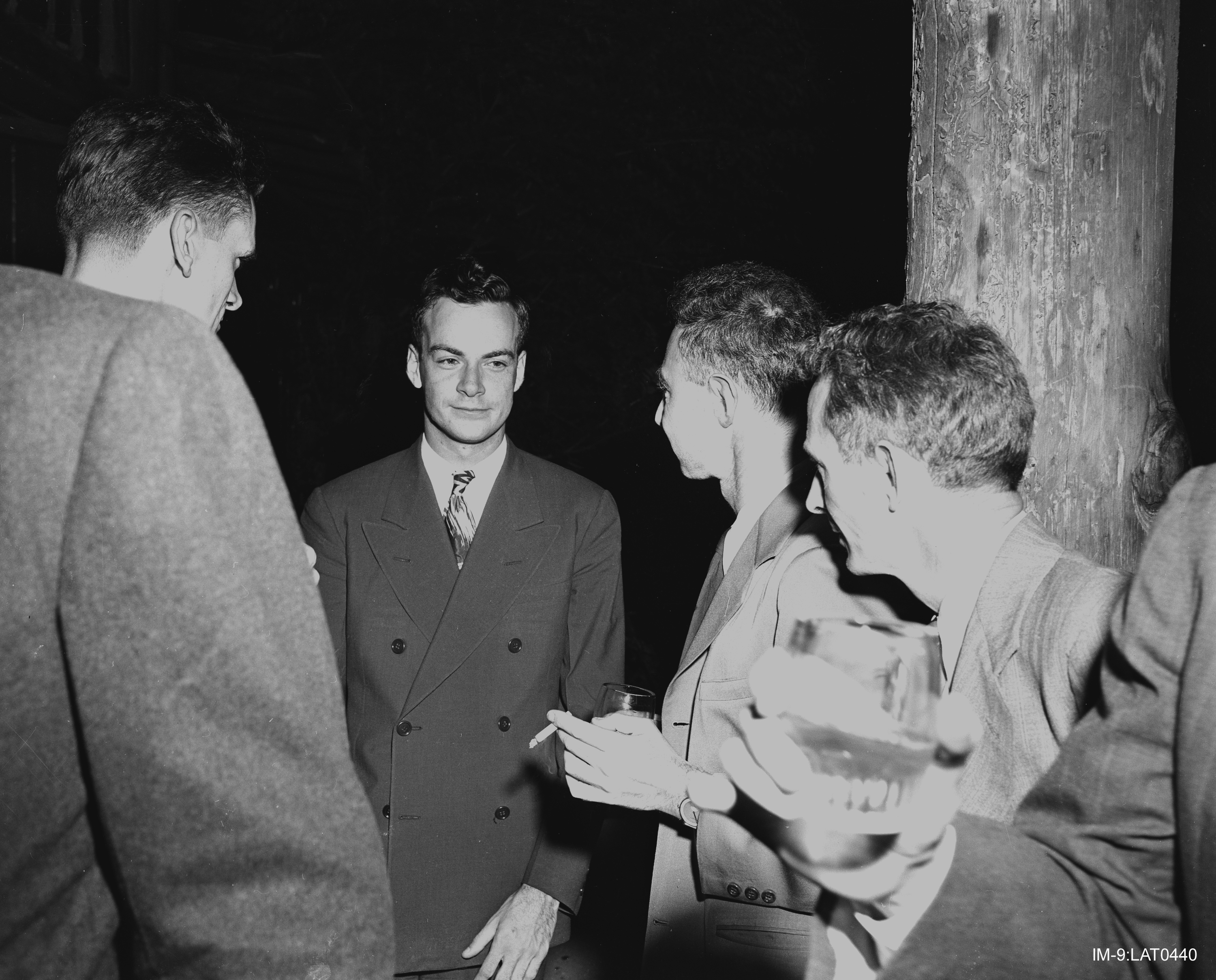 (Public domain)
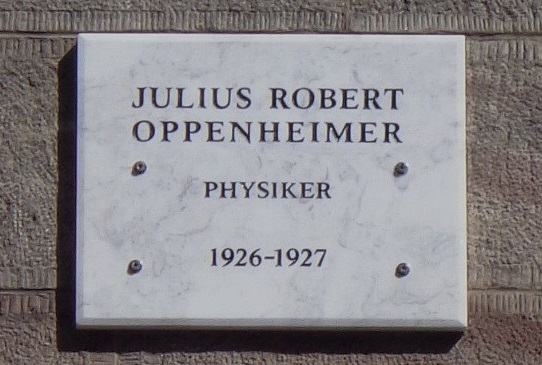 (CC BY-SA 4.0)
 (Public domain)
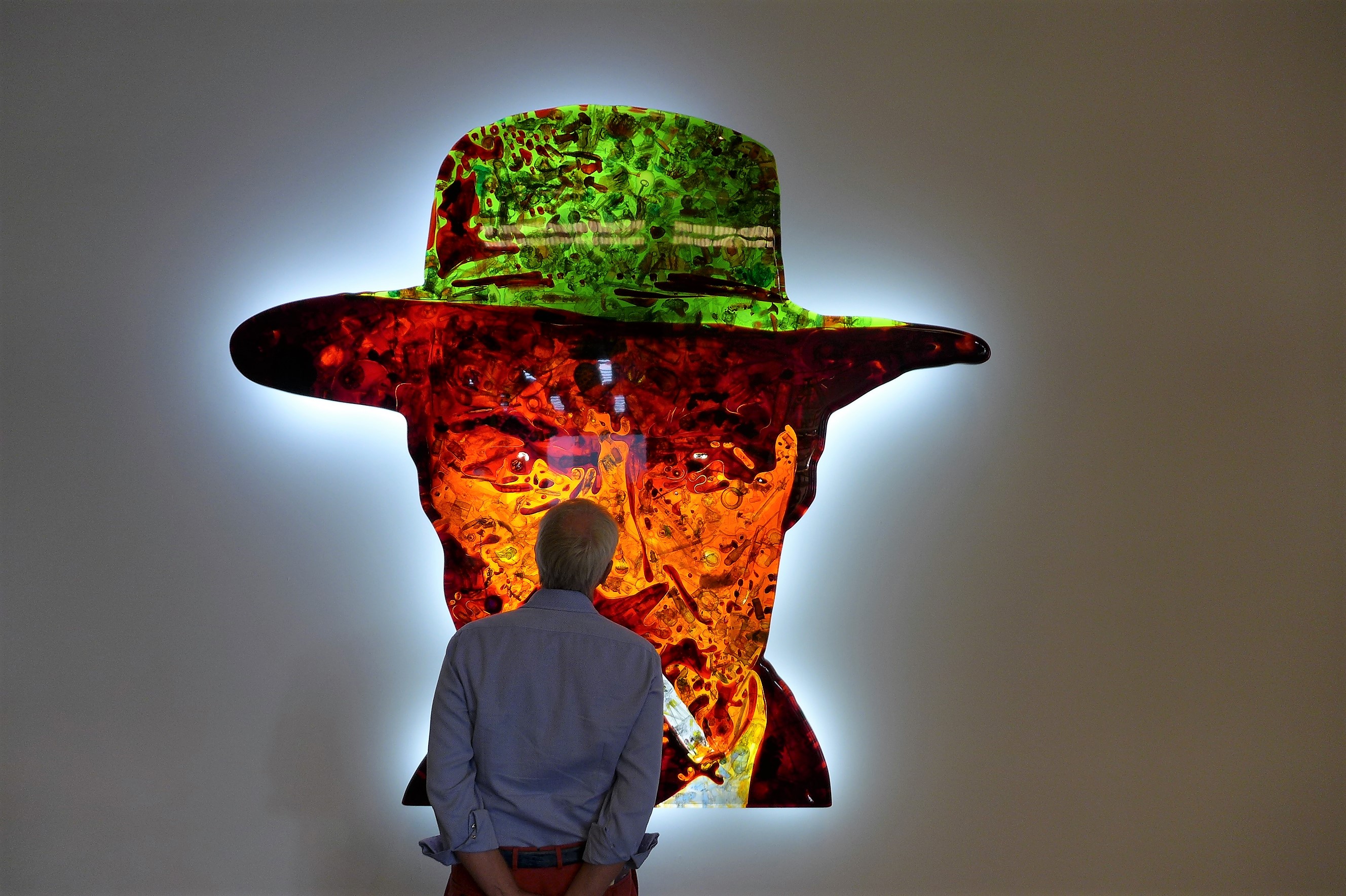 (CC BY-SA 4.0)
 (Public domain)
 (Public domain)
 (Public domain)
 (Public domain)
 (Public domain)
 (CC BY-SA 3.0)
 (CC BY-SA 3.0)
External links
J. Robert Oppenheimer was the American physicist who ran Los Alamos during World War II and built the first atomic bombs. On 16 July 1945 his team detonated 'Trinity' in the New Mexico desert, and three weeks later the weapons obliterated Hiroshima and Nagasaki. Haunted by what he'd helped create — he later said the flash made him think of a line from the Bhagavad Gita, 'Now I am become Death, the destroyer of worlds' — he spent the rest of his life arguing for arms control. In 1954, at the height of the Red Scare, his enemies stripped him of his security clearance in a rigged hearing; the U.S. government formally apologized by vacating that decision in 2022. Christopher Nolan's 2023 film made him a household name again.
For the deep fan: Julius Robert Oppenheimer (1904–1967) is the archetype of the 20th-century scientist-statesman and its most famous cautionary tale. A Göttingen-trained theorist who co-authored the Born–Oppenheimer approximation and, with Hartland Snyder in 1939, produced the first rigorous general-relativistic description of gravitational collapse (the theoretical ancestor of black holes), he built at Berkeley the first American school of theoretical physics capable of matching Europe's. General Leslie Groves, improbably, chose this left-wing, chain-smoking polymath — whose lovers, brother, wife, and graduate students had all been close to the Communist Party — to run Project Y at Los Alamos, where Oppenheimer's synthesis of charisma, administrative genius, and pedagogical clarity delivered working fission weapons in 28 months. Post-Hiroshima he pivoted to the politics of restraint: co-author of the Acheson–Lilienthal plan, chair of the AEC's General Advisory Committee, and, from 1947, director of the Institute for Advanced Study, where he gathered Einstein, Gödel, Dyson, and Yang. His 1949 opposition to a crash H-bomb program, his humiliation of AEC commissioner Lewis Strauss over isotope exports, and long-standing FBI surveillance collided in the 1954 security hearing — a procedurally grotesque inquisition featuring Edward Teller's 'I would prefer to see the vital interests of this country in hands which I understand better' — that stripped his clearance and his policy influence. The 1963 Enrico Fermi Award was partial rehabilitation; the 2022 DOE vacatur of the 1954 decision, and Nolan's 2023 Oscar-sweeping biopic, completed the canonization of Oppenheimer as the moral conscience of the nuclear age — the Prometheus who handed fire to the state and was devoured for doubting what the state did with it.


I can't think that it would be terrible of me to say — and it is occasionally true — that I need physics more than friends.— Letter to his brother Frank Oppenheimer (14 October 1929), published in ''Robert Oppenheimer : Letters and Recollections'' (1995) edited by Alice Kimball Smith, p. 135
Everyone wants rather to be pleasing to women and that desire is not altogether, though it is very largely, a manifestation of vanity. But one cannot aim to be pleasing to women any more than one can aim to have taste, or beauty of expression, or happiness; for these things are not specific aims which one may learn to attain; they are descriptions of the adequacy of one's living. To try to be happy is to try to build a machine with no other specification than that it shall run noiselessly.— Letter to his brother Frank (14 October 1929), published in ''Robert Oppenheimer : Letters and Recollections'' (1995) edited by Alice Kimball Smith, p. 136
It worked!— His exclamation after the Trinity atomic bomb test (16 July 1945), according to his brother in the documentary ''The Day After Trinity''
It is with appreciation and gratefulness that I accept from you this scroll for the Los Alamos Laboratory, and for the men and women whose work and whose hearts have made it. It is our hope that in years to come we may look at the scroll and all that it signifies, with pride. Today that pride must be tempered by a profound concern. If atomic bombs are to be added as new weapons to the arsenals of a warring world, or to the arsenals of the nations preparing for war, then the time will come when mankind will curse the names of Los Alamos and Hiroshima. The people of this world must unite or they will perish. This war that has ravaged so much of the earth, has written these words. The atomic bomb has spelled them out for all men to understand. Other men have spoken them in other times, and of other wars, of other weapons. They have not prevailed. There are some misled by a false sense of human history, who hold that they will not prevail today. It is not for us to believe that. By our minds we are committed, committed to a world united, before the common peril, in law and in humanity.— Acceptance Speech, Army-Navy "Excellence" Award (16 November 1945)
Despite the vision and farseeing wisdom of our wartime heads of state, the physicists have felt the peculiarly intimate responsibility for suggesting, for supporting, and in the end, in large measure, for achieving the realization of atomic weapons. Nor can we forget that these weapons, as they were in fact used, dramatized so mercilessly the inhumanity and evil of modern war. In some sort of crude sense which no vulgarity, no humor, no overstatement can quite extinguish, the physicists have known sin; and this is a knowledge which they cannot lose.— ''Physics in the Contemporary World'', Arthur D. Little Memorial Lecture at M.I.T. (25 November 1947)
The extreme danger to mankind inherent in the proposal [to develop thermonuclear weapons] wholly outweighs any military advantage.— Robert Oppenheimer et al., ''Report of the General Advisory Committee'', 1949
There must be no barriers to freedom of inquiry … There is no place for dogma in science. The scientist is free, and must be free to ask any question, to doubt any assertion, to seek for any evidence, to correct any errors. Our political life is also predicated on openness. We know that the only way to avoid error is to detect it and that the only way to detect it is to be free to inquire. And we know that as long as men are free to ask what they must, free to say what they think, free to think what they will, freedom can never be lost, and science can never regress.— As quoted in "J. Robert Oppenheimer" by L. Barnett, in ''Life'', Vol. 7, No. 9, International Edition (24 October 1949), p. 58; sometimes a partial version (the final sentence) is misattributed to Marcel Proust.
Our own political life is predicated on openness. We do not believe any group of men adequate enough or wise enough to operate without scrutiny or without criticism. We know that the only way to avoid error is to detect it, that the only way to detect it is to be free to enquire. We know that the wages of secrecy are corruption. We know that in secrecy error, undetected, will flourish and subvert.— "Encouragement of Science", an address at Science Talent Institute (6 March 1950), ''Bulletin of the Atomic Scientists'', Vol. 7, #1 (Jan 1951) p. 6-8
We may be likened to two scorpions in a bottle, each capable of killing the other, but only at the risk of his own life.— "Atomic Weapons and American Policy", ''Foreign Affairs'' (July 1953), p. 529
The open society, the unrestricted access to knowledge, the unplanned and uninhibited association of men for its furtherance — these are what may make a vast, complex, ever growing, ever changing, ever more specialized and expert technological world, nevertheless a world of human community.— ''Science and the Common Understanding'' (1953)
The history of science is rich in the example of the fruitfulness of bringing two sets of techniques, two sets of ideas, developed in separate contexts for the pursuit of new truth, into touch with one another.— ''Science and the Common Understanding'' (1954); based on 1953 Reith lectures.
There are no secrets about the world of nature. There are secrets about the thoughts and intentions of men.— Interview with Edward R. Murrow, A Conversation with J. Robert Oppenheimer (1955)
Much has been said of the prospect that man, along with many other forms of life...would disappear as a species. In time, not a long time, that may come to be possible. What is more certain and more immediate is that we would lose much of our human inheritance, much that has made our civilization and our humanity...the threat of the apocalypse will be with us for a long time; the apocalypse may come.— ''Science and our Times'', 1956
It's not that I don't feel bad about it. It's just that I don't feel worse today than what I felt yesterday.— Response to question on his feelings about the atomic bombings, while visiting Japan in 1960.
We waited until the blast had passed, walked out of the shelter and then it was extremely solemn. We knew the world would not be the same. A few people laughed, a few people cried. Most people were silent. I remembered the line from the Hindu scripture, the Bhagavad-Gita: Vishnu is trying to persuade the Prince that he should do his duty and, to impress him, he takes on his multi-armed form and says, "Now I am become Death, the destroyer of worlds." I suppose we all thought that, one way or another.— Interview about the Trinity explosion, first broadcast as part of the television documentary ''The Decision to Drop the Bomb'' (1965), produced by Fred Freed, NBC White Paper; the translation is his own. [http://www.atomicarchive.com/Movies/Movie8.shtml Online video is at atomicarchive.com]
However, it is my judgment in these things that when you see something that is technically sweet, you go ahead and do it and you argue about what to do about it only after you have had your technical success. That is the way it was with the atomic bomb. I do not think anybody opposed making it; there were some debates about what to do with it after it was made. I cannot very well imagine if we had known in late 1949 what we got to know by early 1951 that the tone of our report would have been the same.— Oppenheimer testifying in his defense in his 1954 security hearings, discussing the American reaction to the first successful Russian test of an atomic bomb and the debate whether to develop the "super" hydrogen bombs with vastly higher explosive power; from [http://www.osti.gov/includes/opennet/includes/Oppenheimer%20hearings/Vol%20II%20Oppenheimer.pdf#page=95 volume II of the Oppenheimer hearing transcripts], pg266. Date: Tuesday, April 13.
His early papers are paralyzingly beautiful but they are thoroughly corrupt with errors, and this has delayed the publication of his collected works for almost ten years. A man whose errors can take that long to correct is quite a man.— Memorial lecture delivered on 13 December 1965 at UNESCO headquarters to commemorate the tenth anniversary of Albert Einstein's death, as quoted in Silvan S. Schweber, [https://www.google.com/books/edition/Einstein_and_Oppenheimer/Mpgs6qqNERwC?hl=en&gbpv=1&pg=PA279&printsec=frontcover ''Einstein and Oppenheimer: The Meaning of Genius''] (Cambridge: Harvard University Press, 2008), pp. 279-280.
Science is not everything, but science is very beautiful.— Last published words ''With Oppenheimer on an Autumn Day'', ''Look'', Vol. 30, No. 26 (19 December 1966)
It is a profound and necessary truth that the deep things in science are not found because they are useful; they are found because it was possible to find them.— As quoted in [http://www.math.mun.ca/~edgar/moody.html "Why Curiosity Driven Research?" by Robert V. Moody (17 February 1995)]
Because I was an idiot.— Oppenheimer's explanation for why he lied to security officers on the Manhattan Project about the so-called Chevalier Affair, in which he claimed to have been approached to assist with Soviet atomic espionage during World War II. Testimony of J. Robert Oppenheimer in U.S. Atomic Energy Commission, _In the Matter of J. Robert Oppenheimer_ (GPO, 1954), on 137.
I can make it clearer; I can't make it simpler.— Words spoken to his class at Berkeley during the period 1932-1934, as quoted by Wendell Furry in ''American Prometheus: The Triumph and Tragedy of J. Robert Oppenheimer'' (2005), by Kai Bird and Martin J. Sherwin, p. 84
It's 20 years too late. It should have been done the day after Trinity.— Oppenheimer's reply to a question on Sen. Robert F. Kennedy's efforts to urge President Lyndon Johnson to initiate talks to stop the spread of nuclear weapons, in an interview from the early 1960s. Shown in ''The Day After Trinity'' (1981)
It is my thesis that generally the new things we have learned in science, and specifically what we have learned in atomic physics, do provide us with valid and relevant and greatly needed analogies to human problems lying outside the present domain of science or its present borderlands. ... The general notions about human understanding and community which are illustrated by discoveries in atomic physics are not in the nature of things wholly unfamiliar, wholly unheard of, or new. Even in our own culture they have a history, and in Buddhist and Hindu thought a more considerable and central place. What we shall find [in modern physics] is an exemplification, an encouragement, and a refinement of old wisdom. We shall not need to debate whether, so altered, it is old or new.— J. R. Oppenheimer, Science and the Common Understanding, (Oxford University Press, 1954) pp 9–10.
It is the most beautiful philosophical song existing in any known tongue.— About the ''Bhagavad Gita.'' Quoted without citation in {{cite book|first=Denise|last=Royal|title=The Story of J. Robert Oppenheimer|url=https://archive.org/details/storyofjrobertop0000roya/page/64/mode/2up|publisher=St. Martin's Press|year=1969|page=64}} All later re-quotes lead back to this text.
The Optimist thinks this is the best of all possible worlds, the Pessimist fears it is true.— This is derived from a statement of James Branch Cabell, in ''The Silver Stallion'' (1926) : The optimist proclaims that we live in the best of all possible worlds; and the pessimist fears this is true.
- Enrico Fermi Award (1963-01-01)
- Knight of the Legion of Honour (1958-01-01)
- Medal for Merit (1946-01-01)
- Three Physicists Prize (1958-01-01)
- Nessim-Habif Award (1962-01-01)
- honorary doctorate from Princeton University
- Richtmyer Memorial Lecture Award (1947-01-01)
- Fellow of the American Physical Society
- Foreign Member of the Royal Society (1962-05-03)
- honorary doctor of the University of Calcutta
- Messenger Lectures (1945)
- Officer of the Legion of Honour